Arrival at Beijing West railway station
In the space of 10 years, China went from having no high speed rail at all to then having more than the rest of the world combined. Like many things in the country, it's all at enormous scale: having a billion people in a country the size of Europe tends to do that.
KCR clock tower, next to the Kowloon waterfront
One of Hong Kong's symbols is the clock tower of the former 1910-built Kowloon station of the Kowloon - Canton Railway, closed and demolished in 1975. It's a shame, especially given how it's right next to the Star Ferry to Hong Kong Island.
Star Ferry approaching from Hong Kong Island
The Star Ferry is a HK institution in its own right and is such a scenic way of arriving at Hong Kong Island. It reminded me of the Mersey Ferry in Liverpool, a similar crossing on similar-era boats.
View from Victoria Peak
One of the classic views of the city is from Victoria Peak, accessible from the Peak Tram. Circumnavigating the peak was a very nice walk, with rather spectacular scenery of both the city skyline and the islands of the archipelago.
"Big Question from Little Girl" (2005) and "Corner of a Teahouse" (2004) by Gong Jian, M+ Art Gallery
One of my favourite parts of the visit was to the West Kowloon Cultural District, especially to the M+ art gallery. Some parts were very weird - reminding me of the Tate Modern - but other parts had some very interesting Chinese modern art with all its commentaries on society and politics.
Chinese high speed train at the platform at Hong Kong West Kowloon
My first train ride of my epic journey was from the enormous Hong Kong West Kowloon station to Wuhan. It's the usual scale of Chinese high-speed-rail stations, except with juxtaposed border controls for both the Hong Kong and mainland Chinese borders, much like Eurostar's stations serving London. Travelling around China at 350 km/h is always impressive, and a nice Chinese hot tray meal from the on-board buffet cost me 56 RMB (~£6). After a few days in the now-infamous city of Wuhan, I proceeded to Beijing. Wuhan is a perfectly fine provincial Chinese city with lots of interesting history and scenery, which makes it all the more of a shame that it will now only be known in the West for one thing forevermore.
Train 1: G306 Hong Kong West Kowloon - Wuhan, 1106 km, 4h59
Train 2: G338 Wuhan - Beijing West, 1135 km, 5h18
Wuhan railway station, at the usual scale of Chinese high-speed-rail. The roof design is inspired by the city's bird symbol, the yellow crane.
I've been to both Wuhan and Beijing plenty of times, but it's still nice to visit some of the iconic sights of the national capital. Today's China doesn't do the flag thing very often any more, but it's still quite good at it when it wants to be.
Red flags in front of the national museum in Beijing
After a few days in the capital, my next part of the journey was to the east coast port of Weihai via the city of Qingdao.

Beijing South railway station
Train 3: G1061 Beijing South - Qingdao, 761 km, 4h29
Train 4: C6506 Qingdao - Weihai, 275 km, 1h55
I didn't have very much time in the city of Qingdao, but I've been before - a former German colonial city with much of its Mitteleuropa architectural heritage preserved. It's even kept the German beach tradition.
The Chinese don't usually do sunbathing, but here old habits die hard. Towels ready at dawn, German-style.
So, here started my epic journey: I've travelled extensively across China before, and actually prefer the old-style sleeper trains rather than the high-speed-trains, but it's certainly impressive how good the Chinese are at infrastructure. Turns out that project management is a skill that you don't want to lose, otherwise 🇬🇧 your high-speed lines take 30 years to build and cost 10 times what they should.
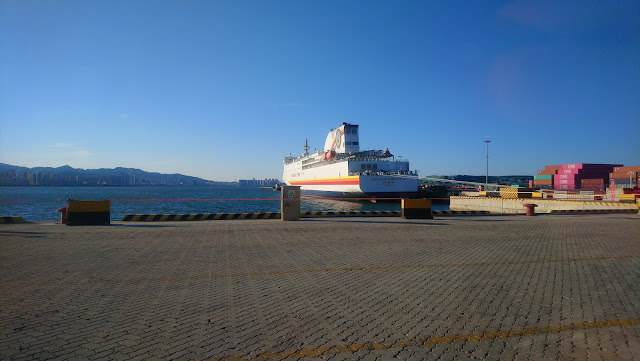
Next, the more novel part begins: China to South Korea by ferry.
Practical note: Chinese train tickets are e-tickets, meaning that you don't get any kind of physical ticket or code. Instead, you enter your ID (passport for foreigners) document number when you buy the ticket, and then staff scan your ID when you enter the station and board the train. In effect, your passport
is your ticket. I bought my Chinese train tickets from
trip.com, which accepts foreign cards but charges a small commission (there does exist a commission-free official website, but it's only useable if you have a Chinese phone number).
Part of my 2023 Oriental overland adventure:




Comments
Post a Comment