 |
Japan Rail Pass
|
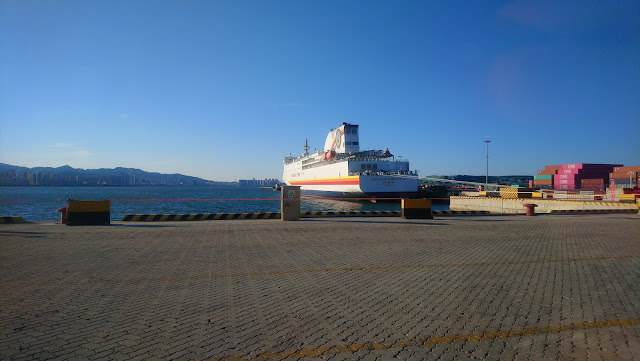
My week in Japan was the part of my trip that I most looked forward to. Having arrived at Shimonoseki station off the ferry from Busan, South Korea, my first task was to collect my Japan Rail Pass. The rail pass could easily have been delivered digitally, like how
InterRail passes in Europe can now be instantly delivered as a QR code
on an app, but instead the purchase process was:
- Buy the pass online through an online travel agent (charging its own commission)
- A
few days later, receive a physical paper voucher with a reference code
on it through (compulsory extra-paid) international post
- Bring the voucher with me to Japan
- Go
to one of a small subset (!) of Japanese rail ticket offices to have my
passport photocopied (onto paper, with other paper forms that the
ticket office bloke had to spend a while filling in and stapling) to
then exchange the voucher for a physical ticket.
Even
if it needed a foreign ID, I don't see any good reason why there can't
just be an official website to buy it and then receive a digital code to
bring to a ticket office to get the ticket printed upon presentation of
a foreign passport. Granted, each part of this process worked very
efficiently, but the overall process was surprisingly inefficient and
paper-heavy. I can certainly see how the country still routinely uses
fax machines or has
a cybersecurity minister who has never used a computer.
 |
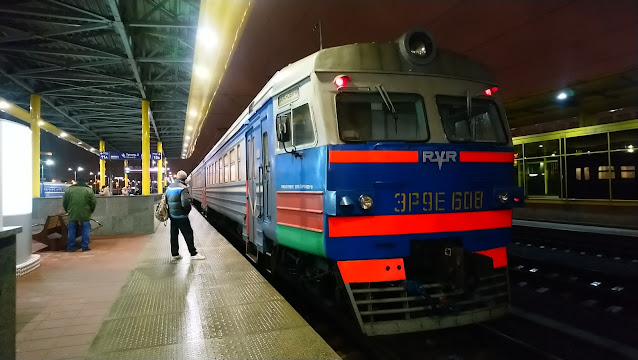
The first train I took with my pass: Shimonoseki to Shin-Shimonoseki
|
Anyway, to business.
Shimonoseki - Shin-Shimonoseki
Shin-Shimonoseki - Hakata
Hakata - Takeo-Onsen
Takeo-Onsen - Nagasaki
 |
Peace Park, Nagasaki
|
First, I took the tram to the Nagasaki Peace Park. For whatever reason, there were lots of school classes having their class photos taken at the park - but it was certainly very interesting to visit the site of the atomic explosion.
 |
Atomic bomb hypocentre, Nagasaki
|
As both a history nerd and a British-Chinese, some of the information boards in the park really didn't sit right with me: presenting World War II as running from 1941-1945, starting from the attack on Pearl Harbor and proceeding with Japan taking successive losses until the bloodshed of the invasion of Okinawa and the deaths in the two atomic bombs. I have lots of opinions about this. Most of the rest of East Asia doesn't get along with Japan, largely because of the legacy of WW2. It's universally not because of what happened at the time (all of Asia is well used to the brutality of
war) but rather they take issue with how Japan treats this history
today*.
 |
Dejima Dutch trading post, Nagasaki
|
On a happier note, the former Dutch trading post at Dejima was a fascinating visit. During one of its long periods of isolation, only the Dutch and Chinese were allowed to trade with Japan and then only in Nagasaki. Dejima was the Dutch trading enclave for 200 years as the only part of isolationist Japan open to westerners. It was lost for centuries, but is now a museum with reconstructed buildings. It was particularly interesting that during the Napoleonic occupation of the Netherlands, this was the only place in the world where the flag of the Dutch Republic flew freely.
 |
Capsule Hotel Cube Hiroshima
|
Nagasaki - Takeo-Onsen
Takeo-Onsen -Shin-Tosu
Shin-Tosu - Hiroshima
I proceeded to Hiroshima, where I stayed overnight in a capsule hotel. It was quite cheap - 3760 JPY (~£19) for the night, with pyjamas, towels and toiletries provided. The capsules were reasonably spacious - around 1m x 1m x 2.5m, and had charging facilities and Wi-Fi. It was spotlessly clean, of course. On the way out of the station it was also quite interesting to see drunken salarymen returning to the station looking rather worse for wear - not just a stereotype.
 |
Hiroshima Peace Memorial Park
|
The Hiroshima Peace Memorial Park was very similar to the one in Nagasaki, and left me with similar opinions. To compare with today, a Ukrainian would certainly be upset at any
Russian city that were to make a Peace Park with a memorial regarding
their Special Military Operation if it were presented like these.
 |
Peace Dome, Hiroshima
|
Even so, it's always interesting to visit locations that I've read lots about, particularly when the Peace Dome has been preserved still surrounded by rubble. My personal conclusion from the two was "play stupid games, win stupid prizes".
 |
Himeji Castle
|
Hiroshima - Okayama
Okayama - Himeji
Onward. Himeji Castle is a superbly reserved castle dating from 1333. It's the very archetype of a Japanese castle.
 |
Udon noodles with tofu, at Menme restaurant in Himeji
|
Delicious, and certainly worth the queue.
 |
Almost a cab-ride on the Himeji - Kyoto metre-gauge railway
|
I could have proceeded to Kyoto on the Shinkansen, but I had some spare time so took the classic metre-gauge conventional train instead. It was great fun, particularly rolling along narrow-gauge at 100 km/h - I'm very much not used to being able to see into the driver's cab and on through the front, so standing here behind the cab was almost like a proper cab-ride. The line went past the Suntory Yamazaki distillery too, which was a nice serendipitous sight.
 |
Kiyomizu-Dera temple, Kyoto
|
I spent the next few days exploring Kyoto with an old friend now in Japan. We visited plenty of temples.
 |
Fushimi-Inara temple, Kyoto
|
Fushimi-Inara is notable for its climb through ~10,000 torii gates...
 |
Kinkaku-ji Temple, Kyoto
|
...while Kinkaku-ji is covered in gold leaf and topped with a Chinese-style phoenix. We visited plenty more over those few days.
Jingu-Marutamachi - Fushimi-Inari
Inari - Kyoto
Kyoto - Umekoji-Kyotonishi
 |
Tonkotsu ramen, Kyoto
|
The food throughout the trip was exceptional.
Saga-Arishiyama - Nijo
Kyoto - Nagoya
Nagoya - Matsumoto
 |
Matsumoto Castle
|
Ueda - Nagano
Nagano - Ueda
I then visited Nagano and its nearby Snow Monkey Park with another local friend - the snow monkeys were very cute, especially where they've developed their own hot spring bathing culture.
 |
Snow Monkey Park, Nagano
|
It was great to meet up with old friends whom I hadn't seen for quite a while, and especially to explore around with a local.
 |
| Zenkoji Temple, Nagano |
Ueda - Tokyo
Tokyo - Shibuya
 |
Shibuya Crossing, Tokyo
|
I proceeded to Tokyo, where there was plenty to do: lots more shrines, lots more food, really enjoying the metropolis.
 |
Tonkatsu and miso, Tonkatsu Maisen Aoyama, Tokyo
|
I stumbled across the Tonkatsu Maisen Aoyama restaurant and went in just because it had a queue. It was delicious, of course.
Harajuku - Meguro
Meguro - Tokyo
Tokyo - Uguisudani
 |
Okonomiyaki, Tokyo
|
Ueno - Shinjuku
 |
Train pushers, Shinjuku Station, Tokyo
|
It was particularly fun to see that the train pushers were still a real thing at Shinjuku station.
Shinjuku - Shibuya
Shibuya - Hamamatsucho
Hamamatsucho - Haneda T2 |
My final Japan Rail Pass journey: the monorail to Haneda Airport
|
It was also nice that because the monorail from Tokyo to Haneda Airport is run by JR, it's also included in the Japan Rail Pass. I thoroughly enjoyed my week in Japan: scenic nature, history everywhere, and amazing food.
Overall, the Japan Rail Pass cost me £194.72 for 1359 km, which is 14.3 p/km. Still relatively expensive even compared to what I'm used to (~10p/km for my journeys around the UK), but definitely good value compared to what Japanese trains usually cost (granted, the Shinkansen is obviously fantastic so you do get what you pay for, but I'm also used to Chinese high-speed-rail which is also considerably cheaper). That said, the price of the JRP went up significantly very soon after I bought it (for the new price, £268, it would be about 20 p/km) so it's now become significantly poorer value than it used to be.
Part of my 2023 Oriental overland adventure:
*For Japan to present WW2 as only being from 1941-1945 is to ignore the reality of its wars and brutal occupations starting from 1931 (a Korean may well argue that it started in
1910) and instead present itself as a victim of the war, not the
perpetrator. Whereas
Germany makes a point of educating its children about the horrors it
perpetrated on the rest of Europe at the same time in history, Japan
notably doesn't: to present the war as four years ending in the atomic
bombings is to present the period as a brief period of victimhood in a
much longer history. South Korea's problem with Japan is not
that the
comfort women
were used as they were, but rather that in Japan the question of
whether or not it even happened is a political question that changes
depending on which party is in power. Every other country in east Asia has similar resentments, and that's even before getting onto the controversy with the
Yasukuni Shrine. Imagine if German schools presented WW2 as only 1944-1945 when Allied forces reached the country's borders, and mentioned nothing about 1933-1944 or the Final Solution, and had a shrine to Himmler and Eichmann and Mengele in the middle of Berlin. It's like that.



Comments
Post a Comment