Kampu Ferry to Japan: Busan to Shimonoseki
 | |||||
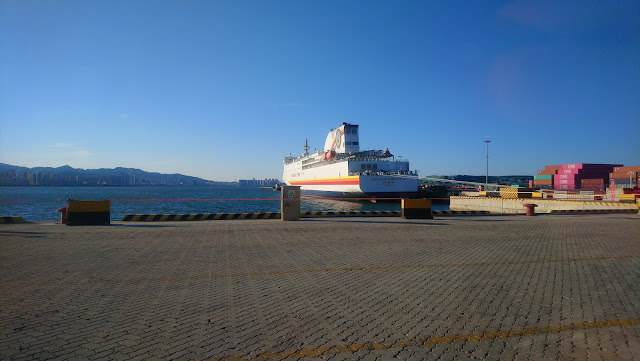
| Hamayuu of Kampu Ferry, docked in Busan Port next to the passenger terminal |
There seem to be plenty of travelogues showing the Busan to Fukuoka fast ferry, but there's very little information on Kampu Ferry's overnight service from Busan to Shimonoseki. I do much prefer overnight journeys like this to save on a night of accommodation and arrive in the morning in a much more time-efficient way. So, here's my attempt to add some detail to what the journey is like.
 |
| Check-in at Busan Port International Passenger Terminal |
The Busan Port International Passenger Terminal is a short walk from Busan railway station along some enormous elevated walkways, just like lots of other ferry terminals. Check-in was from 1730-1850 for the 2100 departure, at the Pukwan Ferry window (seems like Kampu Ferry and Pukwan Ferry are different-language names for the same company). I was handed some forms to fill in, and was then given a boarding pass after I handed those in. This is also where passengers pay the 20000 KRW (~£12) port fee. There was no port fee for arrival in Shimonoseki.
Passengers then proceed through the Departures doors of the terminal to a security check and South Korean exit border control, beyond which there is then a waiting area with a cafe and a duty-free shop. Once it's time to board at around 1900, all the passengers walk down another very long linkspan to then board the ferry.
 |
| The entrance lobby of the ferry Hamayuu. The reception is also here. |
 |
| Carpet class room on the Hamayuu. From glimpses of the private rooms, those had a bunk bed and a desk. |
There were only three passengers in a carpet-class room with 11 places, and very few of the private rooms were also booked.
 | |
| The ship's TV area. The duty-free shop is on the left; karaoke room, smoking room and arcade room to the right. |
The facilities on the ship were supremely Japanese: there was a karaoke room, an arcade-games room, and a TV area showing Japanese television, alongside a small shop selling snacks and duty-free. Most of all, there were even on-board Japanese baths with changing area, bathing pools and showers all communal in the Japanese style. It's quite different to be in a country where bathing is a social activity. There was also a phone-charging station in the main lobby where I had no problem with leaving my phone there while bathing: it's within view of the main reception, and for that matter it's a Japanese ship - petty theft just isn't a thing for the Japanese.
 |
| Room upgrades and the on-board baths are advertised on a noticeboard in the main lobby. |
I had brought my own supplies as I didn't know what to expect in the way of facilities, and there was a hot water boiler available for making things like instant noodles. But the ship did have an on-board restaurant selling canteen-style meals for dinner and breakfast (I recall it was a Japanese dinner and a Korean breakfast), paid by inserting a 1000 JPY note into a vending machine to get a meal token which one can then hand to the restaurant to show that you have paid. Cash-only vending machines: how very Japanese.
 |
| Waking up to the ship entering the Kanmon Straits, separating Kyushu and Honshu. |
Indeed, my overall impression of the ship was that it was supremely provincial-Japanese. It was also very much of its time in being state-of-the-art in 1998, but hardly updated since then. It's still a Japanese-flagged ship though, so the entire ship was immaculately clean and tidy. Everything worked, albeit in an idiosyncratically Japanese way.
 |
| It's quite a view: Honshu on the left; Kyushu on the right. |
The ship arrived at 0745, perfectly on time. Obviously. This is Japan, after all.
 |
| A local tugboat pushes the ship into port in Shimonoseki. |
The passengers then lined up in the lobby to disembark and then walked down the linkspan from the ship to the terminal building, where the immigration control and customs control were reasonably quick. One can then walk along another set of long elevated walkways to Shimonoseki railway station, where I continued my journey.
Welcome to Japan.
 |
| Shimonoseki ferry terminal, with the ferry in the background. |

Comments
Post a Comment